 Elegant Solutions
Your Next Fire Station May Already Exist
Posted October 21, 2026 by Abram Bebo
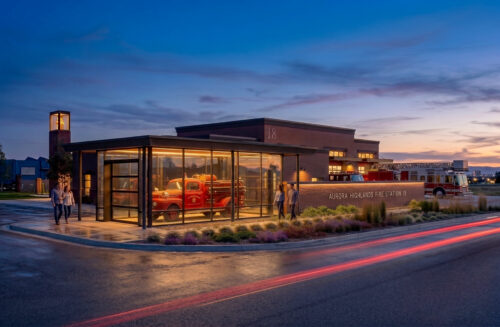
Rethinking Adaptive Reuse for the Next Generation of Fire Stations
Fire stations are among the most purpose-driven buildings a community can build. Every decision, from where a station is located to how crews move through it, ultimately supports one goal: helping first responders serve their communities effectively.
But what if creating the next station doesn’t have to start with an empty site?
As communities grow and the need for public safety infrastructure evolves, existing buildings can present an overlooked opportunity. Adaptive reuse asks a different question. Instead of starting with ‘Where should we build?’, it starts with ‘What do we already have, and what could it become?’
That question is shaping Aurora Fire Rescue’s future Station 18 in The Aurora Highlands, where an existing visitor center is being transformed into a new firehouse. The 9,600-square-foot station is planned to support a full three-shift fire company, fire apparatus and equipment, and a fitness room supporting firefighter health and wellness.
But the significance of the project extends beyond one building. It offers an example of how communities can rethink existing assets to meet entirely new public needs.
Location May Be the Most Valuable Existing Asset
For emergency services, a building isn’t valuable simply because it exists. It has to exist in the right place.
Station 18 is intended to bring firefighters and emergency response resources closer to Aurora’s growing eastern corridor. That makes the location itself part of the adaptive reuse equation.
For fire districts evaluating future facilities, that suggests an important shift in thinking. An existing public or community asset may be valuable not because it perfectly resembles a fire station today, but because its location, site and underlying structure create the foundation for one.
Seeing Potential in an Existing Building
The future Station 18 building has already lived more than one life. It previously served as both a highway maintenance facility and a community sales center before its planned transformation into an Aurora Fire Rescue station.
A fire station has fundamentally different requirements than a visitor center. Apparatus movement, crew living spaces, equipment storage, training, fitness, operational circulation and emergency response all place demands on a building that were never part of its original program.
The design challenge becomes a puzzle: How much of the existing building can work with you, and where does it need to change?
Designing Around What Is Already There
New construction begins largely with a blank page. Adaptive reuse begins with constraints.
Columns are already placed. Walls and openings already exist. Utilities follow established routes. Site access has been defined. Building dimensions are fixed.
The architect’s job, then, becomes less about imposing an entirely new solution and more about determining where to preserve, adapt and intervene. That tension is what makes adaptive reuse both challenging and valuable. Constraints can force the design team to identify what truly matters.
Start With What You Have
For fire districts facing growing service areas, constrained budgets or limited sites, adaptive reuse deserves a place in the earliest planning conversations. Not every building should become a fire station. Sometimes new construction will still be the clearest answer.
Sometimes the future of a fire station begins not with what needs to be built, but with recognizing the possibilities in what is already there.